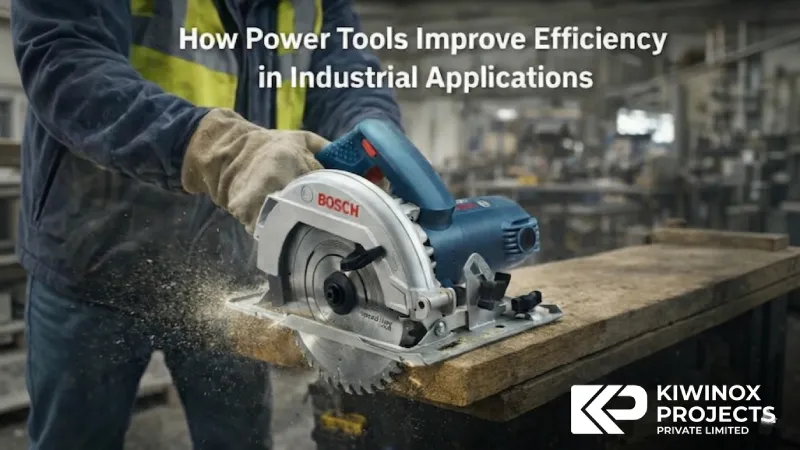
How Power Tools Improve Efficiency in Industrial Applications
Key Takeaways
- Power tools significantly reduce time and manual effort in industrial tasks.
- They improve precision, consistency, and overall output quality.
- Choosing the right tool depends on application, usage, and power source.
- Supplier expertise plays a critical role in making the right purchase.
- A trusted power tools dealer in Mumbai can help optimise your operations.
In the heat of the industrial game time isnt exactly a luxury that you can afford to waste. Delays, manual mucking about and inconsistent output can quietly chip away at your productivity and get in the way of your project timelines. That’s where Power Tools come in – not just as fancy new kit, but as a practical way to sort out some of the operational bottlenecks holding you back.
From fabrication factories to construction sites and maintenance workshops, the switch from manual tools to powered up alternatives has completely flipped how work gets done. Jobs that needed armies of people and endless hours to finish can now be wrapped up faster, with a much better finish and less exhaustion for the workers. If you’re evaluating gear or finding a Power Tools Dealer in Mumbai for your next project, it’s vital to get more than just a basic understanding of how these tools work. You must understand how they will improve your bottom line and assist you control expenses., boost efficiency and just make day-to-day operations a whole lot easier. This blog cuts through the jargon to give you the lowdown – and some help with making better decisions.
What Are Power Tools and Why They’re a Big Deal in Industrial Work
At the most basic level, Power Tools are just tools that use a power source – electricity, compressed air, batteries or the like. But in industrial settings, their role goes way beyond just being a bit more convenient.
They are used to cut, drill, grind, fasten, polish, and shape materials more quickly and precisely than any manual tool could.
Here’s why they matter in real-world industrial scenarios:
- Get you out of the habit of relying on elbow grease
- Give you consistent results every single time you do the same task
- Let you work with precision when it comes to fabrication & assembly
- Handle the toughest materials like metal, concrete and composites
- Enable large scale production – even the kind that needs it
In a nutshell, they turn hard work into results more efficiently – and that has a direct impact on project timelines and operational expenses.
How Power Tools Improve Efficiency in Industrial Applications
Efficiency isn’t just about speed. It’s about doing more work in less time, with fewer errors and better outcomes. Here’s how Power Tools contribute to that:
1. Faster Task Completion
Manual processes take time, especially for repetitive or heavy-duty tasks. Power tools significantly reduce cycle time.
- Drilling multiple holes in steel plates
- Cutting large volumes of material
- Grinding and finishing surfaces
These tasks become quicker and more manageable. For example, using an angle grinder instead of manual filing can cut processing time by more than half in certain operations.
2. Improved Precision and Accuracy
In industries like fabrication or machining, even small inaccuracies can lead to rework or material waste.
Power tools offer:
- Controlled speed settings
- Stable handling mechanisms
- Consistent performance
This results in cleaner cuts, accurate drilling, and better finishing—reducing errors that cost both time and money.
3. Reduced Worker Fatigue
Manual tools demand physical effort, especially over long shifts. Fatigue affects performance, safety, and output quality.
Power tools help by:
- Minimising physical strain
- Reducing repetitive manual motion
- Allowing workers to focus more on control than effort
This leads to better productivity over longer working hours without compromising quality.
4. Consistency in Output
In industrial environments, consistency matters as much as speed.
Using Power Tools helps maintain:
- Uniform cuts and finishes
- Standardised drilling depth and alignment
- Repeatable results across batches
This is especially important in manufacturing and assembly processes where variation can disrupt the entire workflow.
5. Capability to Handle Heavy-Duty Work
Certain tasks simply cannot be done efficiently with manual tools.
Power tools are built to handle:
- Hard metals and alloys
- Thick materials
- Continuous operation under load
This expands what your workforce can achieve without needing specialised machinery for every task.
Common Industrial Applications of Power Tools
Different industries use power tools in different ways, but the core advantage remains the same efficiency.
Here are some typical applications:
- Construction: drilling, cutting concrete, fastening structures
- Fabrication: metal cutting, grinding, polishing
- Automotive workshops: tightening, assembly, repair work
- Maintenance operations: dismantling, repairs, replacements
- Manufacturing units: repetitive assembly and finishing tasks
For example, in a fabrication workshop, switching to high-performance grinders and drills can streamline the entire production line, reducing idle time between processes.
Types of Power Tools Used in Industrial Settings
Choosing the right tools depends on the application. Some of the most commonly used categories include:
- Electric drills and hammer drills
- Angle grinders
- Impact wrenches
- Circular saws
- Sanders and polishers
- Rotary tools
Each tool serves a specific function, and selecting the right combination can significantly improve workflow efficiency.
How to Choose the Right Power Tools for Your Industrial Needs
Selecting the right tools is where many businesses get it wrong. Buying based only on price or brand without understanding usage can lead to inefficiencies.
Follow this practical approach:
1. Define the Application
Understand exactly what tasks the tool will perform. Cutting metal requires a different tool than cutting wood or concrete.
2. Evaluate Usage Frequency
- Occasional use → standard tools
- Continuous industrial use → heavy-duty, durable models
3. Check Power Source Requirements
- Electric tools for consistent indoor work
- Pneumatic tools for high-power industrial setups
- Battery tools for mobility
4. Focus on Ergonomics and Safety
Comfortable handling reduces fatigue and improves control, especially for long working hours.
5. Work with a Reliable Supplier
A knowledgeable Power Tools Dealer in Mumbai can guide you based on your actual application, not just sell products.
This step often makes the biggest difference between a smart purchase and a costly mistake.
Real-World Impact: A Practical Example
Consider a mid-sized fabrication unit handling steel component. Earlier, manual tools were used for grinding and finishing. This resulted in:
- Longer processing time
- Inconsistent surface finish
- Higher worker fatigue
After shifting to industrial-grade Power Tools, the same unit experienced:
- Faster turnaround time
- More consistent finishing quality
- Reduced rework
This is not about technology replacing labour—it’s about enabling better output with the same workforce.
Why Supplier Selection Is More Important Than You May Imagine
Many businesses underestimate the role of the supplier. But in reality, the right supplier helps you:
- Choose the correct tools for your application
- Avoid underpowered or unsuitable equipment
- Get guidance on usage and maintenance
Working with an experienced Power Tools Dealer in Mumbai adds practical value, especially when you’re dealing with industrial-scale requirements.
Why Choose Us
At Kiwinox Projects, we’re not just in the business of selling Power Tools – we actually get what you need to get the job done. We take the time to figure out what kind of work you do, how often you use these tools, and what kind of headaches you’re dealing with on-site. We don’t just give you some generic options – we want to point you in the direction of the tools that will actually make your workflow better and make you more productive. We have a good grasp of what really matters in the industrial world and our products (which we’ve carefully chosen for you) are all about giving you the right tools to get the job done, not just selling you something for the sake of a quick sale. The difference shows up where it counts – on the ground, when you’re actually working.
Conclusion
Power tools have become the lifeblood of modern industrial operations – they aren’t just a convenience; they actually make a real difference to how efficiently you work. They cut out the drudge work, speed things up, and bring a level of consistency to tasks that previously relied on skill and time. All of this means better output for businesses, fewer delays and better control over costs over time. But the real key to making the most of power tools is choosing the right ones for the job you’re doing. When you work with someone who actually understands what you need and can supply you with the right tools, it makes all the difference. When used properly, power tools aren’t just a helpful tool – they can actually make the whole process work better from start to finish. make decisions based on what you actually need, rather than just making a wild guess, you’ll see the benefits come through naturally. In the end, strong welds build strong businesses – and that starts with the right gear and the right partner.
Looking to upgrade your industrial efficiency with the right tools? Call +91 8239655961 or email kiwinoxprojects@gmail.com for expert guidance and tailored Power Tools solutions.
FAQs
What are the main advantages of using power tools in industry?
They improve speed, reduce manual effort, and provide consistent results, making operations more efficient and cost-effective.
Are power tools suitable for heavy-duty industrial work?
Yes, industrial-grade tools are designed to handle continuous use and tough materials like metal and concrete.
How do I choose the right power tool for my needs?
Start by identifying your application, usage frequency, and required power source, then consult a reliable supplier.
Do power tools require regular maintenance?
Basic maintenance like cleaning and checking components helps maintain performance and extends tool life.
Why should I buy from a Power Tools Dealer in Mumbai instead of online marketplaces?
A local dealer offers better guidance, product suitability advice, and after-sales support tailored to industrial needs.