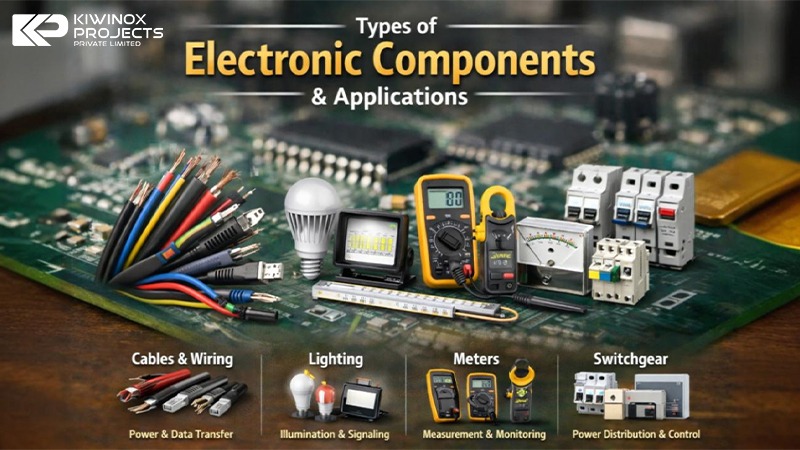
Every device you use, every system you depend on, and every piece of kit plodding away in the background is based on Electronic Components. Now, they may look simple at first but let’s be clear, their jobs are anything but basic. Each resistor, capacitor, and semiconductor takes a load of careful engineering, sound decision-making, and has a very specific job to do.
Understanding Electronic Components
At the heart of all electronic systems are the Electronic Components. They’re individual bits, designed to control, direct or regulate those electrical signals. And each one’s got a distinct role to play. Some store energy, some keep the current in check & some pump up the signal. And when you put them all together, you get the electronic circuits that are at the heart of every industry.
Electronic components fall broadly into three categories:
- Passive Components
- Active Components
- Electromechanical Components
Each category exists for a reason. Each has real-world applications.
Passive Electronic Components
Passive components work without external power sources. They do not amplify signals.
- Resistors: Resistors limit current flow. Simple job. Critical role. They protect sensitive components from damage and help divide voltage across circuits. Used in almost every electronic device—consumer electronics, control panels, industrial automation systems.
- Capacitors: Capacitors store and release electrical energy. Short bursts. Quick response. They smooth voltage fluctuations and stabilize power supply lines. Commonly used in power supplies, audio systems, and signal-filtering setups.
- Inductors: Inductors store energy in a magnetic field. They resist sudden changes in current. Often used in power supplies, radio frequency circuits, and noise filtering systems.
Passive components may look basic. They are not optional. Without them, circuits fail.
Active Electronic Components
Active components require external power to operate. They control current flow and amplify signals.
- Diodes: Diodes let electric current pass in only one direction. Essential for rectification. Used in power conversion, signal demodulation, and circuit protection.
- Transistors: Transistors act as switches or amplifiers. They are the backbone of modern electronics. Found in computers, communication devices, motor controllers, and automation systems.
- Integrated Circuits (ICs): Integrated circuits bring several electronic components together on a single chip. Compact. Efficient. Powerful. Used in microcontrollers, processors, memory devices, and control systems.
Active Electronic Components define intelligence in electronics.
Electromechanical Components
These components combine electrical and mechanical operations.
- Relays: Relays use electrical signals to control mechanical switching. Ideal for isolating high-power circuits from low-power control systems. Common in industrial automation and safety systems.
- Switches and Connectors: Switches control circuit operation manually or automatically. Connectors provide reliable electrical connections between systems. Without them, systems stay disconnected. Literally.
Applications of Electronic Components
Electronic components power industries you rely on every day.
- Consumer Electronics: Smartphones, televisions, laptops, home appliances. All depend on reliable Electronic Components for performance and safety.
- Industrial Automation: Control panels, PLC systems, sensors, and motor drives rely on accurate component selection for long-term reliability.
- Power and Energy Systems: Inverters, UPS systems, power distribution units. Components manage voltage, current, and protection.
- Automotive Electronics: Modern vehicles use hundreds of components for safety, navigation, control, and entertainment.
- Medical Equipment: Precision matters. Diagnostic machines, monitoring systems, and imaging equipment depend on stable, compliant components.
Importance of Quality Sourcing
Not all components perform the same. Quality impacts lifespan, safety, and compliance. That’s the moment when a dependable electronic components dealer and distributor in Ahmedabad truly becomes essential.
Poor sourcing leads to system failures. Delays. Cost overruns. Compliance risks. Choosing the right partner avoids these issues.
Role of a Trusted Dealer and Distributor
A dependable electronic components dealer and distributor in Ahmedabad offers far more than just product supply. They support selection, ensure traceability, and provide consistent availability. This matters when timelines are tight and standards are strict. Kiwinox Projects Pvt. Ltd works closely with clients to match application needs with suitable components. No shortcuts. No confusion.
Product Range at Kiwinox Projects Pvt. Ltd
Kiwinox Projects Pvt. Ltd offers a focused range of electronic products aligned with industrial and commercial needs. The product portfolio supports automation, power management, control systems, and general electronics applications. Each product category reflects practical usage, not generic listings. The approach stays simple. Understand requirements. Match specifications. Deliver reliable solutions.
Why Choose Us
Kiwinox Projects Pvt. Ltd – We’re the ones who keep things simple and straightforward. Our team gets components, not just part numbers – we know what they do and where they fit in. Clients choose us because they can depend on us for sourcing, they know we’ll keep them in the loop, and we’re always there to lend a hand regardless of the industry. As a trusted dealer and distributor of electronic components in Ahmedabad, Kiwinox Projects is steadily building a reputation for being reliable and having our clients’ backs. We focus on picking the best component for the job, getting it delivered on time, and building long-term relationships. No over-promising, just solid honest service that businesses can count on time and time again.
Conclusion
Electronic systems only work when all their components are doing their thing. Whether passive resistors or state of the art IC’s, every single one’s importance can’t be overstated. It’s good to understand the different types out there and where they’re used – which makes it so much easier for businesses and engineers to make the right decisions. At Kiwinox Projects, our goal is to support this kind of informed decision making with a focused product and service offering that’s based on real world experience. When you get the right component, you reduce risk, get better performance, and build a system that’ll last.
Want deeper insights into Types of Electronic Components & Applications? Call +91 8239655961 or email kiwinoxprojects@gmail.com to explore reliable component solutions tailored to your needs.
Key Takeaways
- Electronic Components form the foundation of all electronic systems.
- Passive, active, and electromechanical components serve distinct roles.
- Application-based selection improves performance and lifespan.
- Trusted sourcing reduces operational and compliance risks.
- Kiwinox Projects Pvt. Ltd supports informed, reliable component decisions.
FAQs
What are Electronic Components used for?
They control, store, and regulate electrical energy in electronic systems across industries.
Why is component quality important?
Quality affects performance, safety, compliance, and system longevity.
Who relies on an electronic components dealer and distributor in Ahmedabad?
Manufacturers, system integrators, automation companies, and maintenance teams all do.
Do all electronic devices use passive and active components?
Yes. Both categories work together to form complete circuits.
How does Kiwinox Projects Pvt. Ltd support buyers?
By offering application-focused products, technical clarity, and consistent supply.